Wednesday, September 17, 2008

Interdependence


When it comes to interdependence our school needs to make sure that while investing in imports, we aren't damaging the surronding environments and communities. Our school has made a consist effort to buy food locally, and have made decesions that best help our environment. Our primary vendor for food is Costa Fruit & Produce who is located in Boston and has won several awards for being environmentally friendly. They are not part of a national chain because that is what our school wants to get away from to avoid damaging the environment. For produce we buy from Saunders Produce in Somersworth who recieve their products from local farmers. The ice cream we purchase comes from NE Ice Cream in Massachusets which is also not a national chain. Whenever the school gets the chance, our food is purchased locally from farmers in Lee. Another thing to note is that our cafeteria tries to not have any wasted food. They know exactly how much to make each time so that there's enough food to feed the students, but their isn't a lot of food being trashed.
Another part of interdependence is being mutually responsible. We all need to understand our own responsibilities we have to make our school a sustainable community. One major issue we have when it comes to this is the amount of cars that we have at the school. The amount of gas we could prevent from using is incredible if we look to alternatives for modes of transportation to school. As of now almost everyone I know takes their own car to school, if we could sacrifice the convenience of taking our own cars the amount of fuel we could save would be tremendous. Something the school should look into is making parking permits more expensive, to make carpooling and buses more attractive. Some people don't take the bus because they have places to be during the buses hours. But a lot of kids drive to school, and then drive right back home. This is something our school needs to look into, and it's something that could easily be pursued.
All in all our school has made an obvious effort to reduce their environmental impact. Nevertheless, there are a lot of easy steps that could be taken in strengthing out interdependence. For interdependence ORHS reserves a B-.

Renewability and Substitution


Students of Oyster River High School love to tell themselves that “green is the way to go” and that we are an extremely environmentally friendly school as well as society. However, when put into perspective and investigate it is quite apparent that Oyster River High School is not an extremely environmentally friendly school.

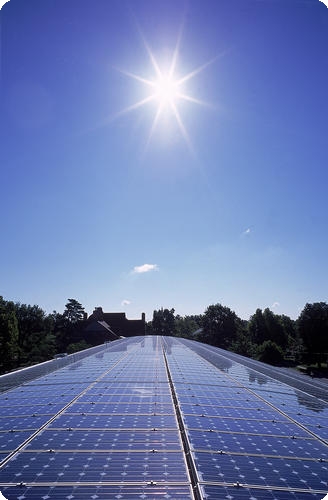
Establishments that consider themselves very environmentally friendly places usually utilize renewable energy. This can be anywhere from harvesting solar energy, harvesting wind power, or using bio-diesel fuel. Oyster River High School does not harvest solar energy, harvest wind power, and as of this year no longer attempts to use bio-diesel fuel. Does this mean that there is no chance to ever becoming a school that uses these services? Most definitely not, but what it does mean is that many changes do need to take place. Even though wind power and solar energy can be a great way to change, even smaller steps can be put into place. Some of these steps are simple and are ones that everybody has the power to accomplish. Students and faculty can make a conscious effort to recycle their milk bottle after finishing lunch rather than tossing it in the bin. According to the administration and janitorial staff of Oyster River High School, a large majority of recycling has to be discarded because people are careless and place items that are non-recyclable in the recycling receptacles. This can range from non-recyclable plastics to left over food from a meal. As stated before, both of these flaws can easily be corrected if staff and students simply disregard their items in the correct container. Another step that can be taken is using less paper. It is very likely to walk past a printer and see stacks of paper that have been printed but not ever used for anything. This step can be fixed as well, just print what is needed and nothing more. These bad habits can be changed as long as members of Oyster River High School substitute the bad for the good: recycle the correct materials and minimize paper use. It is quite possible that if these small steps are taken now that the bigger steps (solar power and wind power) could be taken in the future.

Grade: Oyster River High School receives a grade of a B-/C+ when it comes to substitution and renewability. People are trying to do these things and are talking about doing them, so all that needs to take place is the actual physical action of them happening.

Sunday, September 14, 2008

Adaptability


When we look at Oyster River in terms of Adaptability, what do we think? I think of Oyster River and its changes or its attempts to be changed. For example, The Oyster River Community had a vote on whether or not to construct a turf stadium for not only the students of Oyster River High School, but for the whole district. That bill was quickly turned down by the people of the OR District because of money. Building these expensive fields would increase taxes for people all over the community. According to Gaylord Nelson's five characteristics, he said that adaptability requires a diversified economy, educated citizens, and a spirit of solidarity.
I think that the Oyster River High School doesn't like to adapt to new things unless it's forced upon. When something is optional and a few kids can create changes, it doesn't seem as effective as if an administrator or teacher forced change somewhere in the school. For example, out of all the four years I’ve been at ORHS, I've been constantly hearing that our school doesn't recycle and everything gets trashed. The many students of ORHS blame it on the janitors and don't do a single thing about it. Why doesn't anyone change this and volunteer their time to sort out the recycled waste with the actual waste? Talk is what we love to do, but committing and actually taking action for something you said is a completely different story. If enough people participated, took responsibility and committed towards change such as sorting the recycled waste, carpooling to school, picking up trash after lunch, etc., then we would be getting somewhere.
Gaylord Nelson is completely right when he says that in order to establish adaptability, a community needs to have educated citizens and its citizens need to have feelings, take responsibilities, and have some sort of interest for their community. Ignorant students are constantly saying how driving their car to school has an affect on the environment, or saying, “Why should I recycle if the school doesn’t actually recycle and puts everything in the same trash stash.” A lot of people in our school just don’t care. They feel as if keeping ORHS sustainable is not a concern and it has no purpose and a lot of students just don’t want to have the responsibility of keeping a school sustainable. There are definitely some students and teachers who care, are responsible, and try whatever they can to make ORHS sustainable, but it’s not enough. So much of the ORHS students don’t care, that it’s going to take us a very long time to adapt to a maintainable and sustainable school environment.
Changing ORHS' sustainability is a hard task and it needs a lot of involvement with not just students, but teachers and administrators as well. If the strong words of the teachers and administration got to the students, something would start happening and we could change the sustainability at ORHS. The administration has done a pretty good job of putting one or more recycling bins in each classroom, but the students have done a pretty bad job choosing between the trash can and the recycling bin. Custodians don't have time to sort out recycled and non-recycled material; they have a whole school to look after! Students like us that are in an environmental science class should start by keeping this system organized so we can eventually adapt to sorting everything out and not have problems with recycling.

Final Assessment: Based on this article, it seems to me was I mostly criticized the sustainability at ORHS. I was just trying to show how much more we need to do to adapt into a sustainable environment. We’re at a point where half the student body cares about our school and how it ends up, then the other half just doesn’t care and doesn’t see a purpose for keeping our school sustainable.

I’d probably give our school somewhere in the C range because the whole school is basically split down the middle with one side caring and the other not. We can improve this through more propoganda of the issues to create more awareness.

Saturday, September 13, 2008

Institutional Commitment


I am going to be talking about the institutional commitment at ORHS. The institutional commitment is the school/communities actions in adopting rules/regulations to promote awareness for the environment, and to promote sustainable production and consumption. I’m going to grade our school based on these elements. First off, the fact that our school offers an environmental science class is remarkable, and shows a huge amount of dedication. That gives students the opportunity to learn about the problems our generation faces, and the debacles we have to solve. Without the environmental science class provided by the school, this blog wouldn’t be here.
Our school has a lot of recycling bins which most everyone questions. After talking to Mrs. Rogers, and some janitors, we found out, that it is dumb students who contaminate the recycling who mess everything up; If the janitor notices the bin has a lot of contamination he/she will proceed to put it with the trash. But if the bin is not contaminated they will recycle it.
Something that would help our schools sustainability would be the addition of a compost program. A compost program would reduce a huge amount of our schools waste, and would be beneficial in the help of the soil in our school’s grounds. A compost program is something that would take a lot of effort, and cooperation from the schools students, and administrators. It is something that should definitely be looked into more, and it would be a huge waste saver.
Having the environmental science class gives people the facts to be aware of sustainable behavior. The environmental science class in turn shares their knowledge to the students. But the school could do a little more to promote sustainable living. One thing is that if they catch a kid contaminating the recycling they should be suspended, or if they put recyclable products in the trash they should be suspended or expelled. This would surely help the recycling problems at our school. Also there are bio-degradable plates and one-time use silverware made from potatoes that our school doesn’t yet invest in.
Nevertheless there is one rule that you could say is environmental friendly. There is no smoking allowed on ORHS school grounds. Cigarette smoke puts toxins into the air, and is very bad for the air quality. ORHS prevents just a little of this smoke, but a little bit makes somewhat of a difference.
Our school uses bio-diesel for its buses, and that is better than gas powered buses, but there are still emissions being poured into the air. Our energy doesn’t come from wind mills or solar panels, which are both things are school should have looked into when making the new school. Our energy isn’t environmental friendly, but we have implemented motion sensors that turn off the lights when no one is in a room. But we still should invest in wind-mill energy or solar panel- sun energy.

Bottom Line: Overall our school has fairly good institutional commitment, but it still needs a lot of work. We can improve in a lot of facets, and our school is definitely headed in the right direction. ORHS receives a grade of: C+

Thursday, September 11, 2008

Here is a description of Gaylord Nelson's 5 characteristics. But 1st I want to let you know who Gaylord Nelson is. He was a Senator from Wisconsin, who founded Earth Day, and was a huge advocate for environmentalism in the in the 1970's and 80's and he preached sustainability. A sustainable lifestyle, is one that doesn't hurt its surronding community and environment while using resources. Gaylord Nelson passed away in 2005, but his influence still lives, here are his 5 characteristics of Sustainability. (*)

1. Renewability- Community must use renewable sources such as water, topsoil, and energy sources no faster than they can replace themselves. It cannot exceed the rate of generation.
2. Substitution- A community should use renewable instead of nonrenewable resources. To be sustainable, a community has to make the transition before the nonrenewable resources become little.
3. Interdependence- A sustainable community recognizes that it's a larger system and that it cannot be sustainable unless the larger system is also sustainable. Does now import goods so that it's richer than other communities nor does it pollute other communities.
4. Adaptability- A sustainable community can absorb shocks and adapt to take advantage of new opportunities. It requires a diversified economy, educated citizens, and a spirit of solidarity.
5. Institutional Commitment- A sustainable community adopts laws and political processes that mandate sustainability. It supports sustainable production and consumption. Teaches people how to value and practice sustainable behavior.